A Close Look at the Numbers Beyond the Final Score
Denver Broncos vs Los Angeles Chargers matchups carry a mix of rivalry and competitive intrigue in the AFC West, and when you dig into the player stats from their recent games, you see how individual performances shape the outcome beyond just the win-loss column.
This article explores the key player contributions from the most recent Broncos–Chargers clashes, focusing on meaningful statistics that tell the story of how these teams have battled on the field. You’ll get passing, rushing, and receiving numbers, defensive plays, and how those efforts translated into game momentum — without any fluff or data dumps.
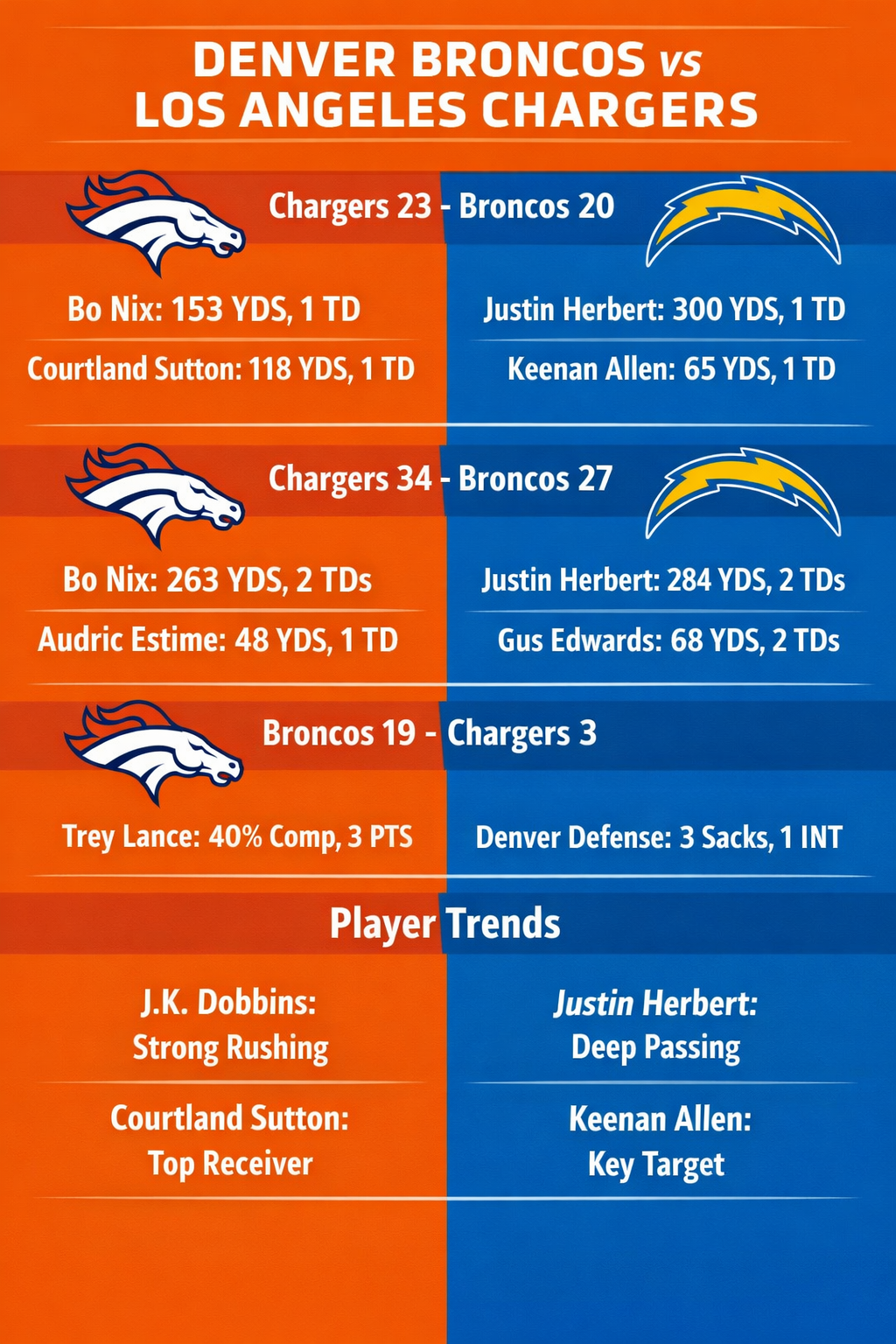
Game 1: Chargers 23, Broncos 20 (2025 Season)
In the 2025 regular-season meeting in Inglewood, this AFC West matchup lived up to its reputation for competitiveness right to the final minute. The Chargers edged the Broncos 23–20 on a last-second field goal — a result built as much on situational play as on standout individual efforts.
Offensive Leaders
Chargers
- Quarterback (Justin Herbert): Threw for roughly 300 yards and a touchdown, anchoring a balanced passing attack.
- Keenan Allen (WR): Hauled in seven receptions for 65 yards and a TD, proving reliable in key moments.
- Quentin Johnston: Added six catches for 89 yards, giving the Chargers a vertical threat.
- Omarion Hampton (RB): Rushed 19 times for about 70 yards and a score, showing patience and burst in the second half.
Broncos
- Bo Nix (QB): Managed the offense with 153 passing yards, one TD, and added 33 yards on the ground.
- Courtland Sutton (WR): Tallied six catches for 118 yards with a touchdown — a true vertical playmaker.
- J.K. Dobbins (RB): Ran 11 times for 83 yards and a touchdown, showing a decisive downhill style.
Observations
This game showcased a common dynamic between these teams: Denver’s offense often goes through its run game and short passes to set up big plays, while the Chargers lean on Herbert’s arm and variation in receiver targets to sustain drives. Denver’s defense held firm late, but a pivotal final drive gave Los Angeles the edge.
From a stats perspective, the Chargers’ ability to stretch the field and convert in critical moments made the difference — even if total yardage and scoring plays looked relatively close on paper.
Game 2: Chargers 34, Broncos 27 (Dec 19, 2024)
Looking at a prior season’s late-year game, the Chargers again found a way to outscore Denver in a high-offense setting. These recurring trends suggest that when both teams lean into balanced attacks, the one with sharper execution — often remaining consistent across all three phases — tends to pull ahead.
Key Performers
Passing
- Bo Nix (DEN): Completed enough passes for 263 yards and two TDs, showing his growth as a game manager.
- Justin Herbert (LAC): Finished with 284 yards, two TDs, but also threw an interception.
Rushing
- Gus Edwards (LAC): Put up a strong ground game with 68 yards and two touchdowns — the kind of consistent rushing attack that keeps defenses honest.
- Audric Estime (DEN): Led the Broncos ground attack with 48 yards and a score on nine attempts.
Receiving
- Ladd McConkey (LAC): Reed in six balls for 87 yards, one of the top targets on the Chargers.
- Marvin Mims Jr. (DEN): Contributed 62 yards receiving, adding another vertical option for the Broncos.
Observations
This matchup emphasizes how complementary football — strong rushing, timely passing, and secondary production — often decides AFC West contests. Even if Denver generated yardage, the Chargers managed more offensive balance and capitalized in key situations.
Game 3: Broncos Dominate (Broncos 19, Chargers 3 — Jan 2026)
Late in the 2025–26 season, Denver put together a methodical, low-scoring win over a Chargers team that had rested starters and rotated personnel late. This game looked different statistically because of the absence of key Chargers offensive players, including Justin Herbert and Derwin James.
Standout Stats
- Trey Lance (LAC): Struggled through the air with just over 40% completion and a passer rating in the 40s.
- Denver Defense: Pressure and coverage held Los Angeles to only a field goal, a sign of discipline and situational awareness in all three downs.
- Broncos Rushing: Denver controlled the clock with a steady ground attack, controlling field position and tempo.
How Player Absences Affected Numbers
With multiple Chargers starters inactive, including Herbert and James, Los Angeles lacked its usual offensive rhythm and defensive stability. That translated into modest yardage totals and limited scoring. Denver, meanwhile, kept its offense crisp and efficient, showing how depth and flexibility matter over a long season.
Deep Dive: Player Roles and Trends
Beyond the box scores, some patterns stand out in these matchups:
Quarterback Play Matters
When Herbert is at full strength, Los Angeles tends to generate more explosive plays and consistent drives. His ability to push the ball downfield — especially in clutch moments — significantly impacts the Chargers’ competitive edge. Against Denver, his stat lines often reflect higher yards and involvement in scoring drives.
Bo Nix, meanwhile, has emerged as a dual-threat; his rushing ability adds a wrinkle that defenses must respect. While not as prolific as Herbert in pure passing yardage, his balance helps sustain tempo and keep defensive fronts honest.
Running Backs Set the Tone
Denver’s J.K. Dobbins has shown he can carry the load reliably, producing hard yardage on the ground and a few timely scores. For the Chargers, running backs like Gus Edwards and Omarion Hampton have mixed rushing work with short receiving targets, a balanced approach that keeps opponents off balance.
Receivers and Separation
Courtland Sutton remains one of Denver’s most consistent weapons, generally topping receiving charts in these games. On the Chargers’ side, Keenan Allen’s presence is steady, though players like Quentin Johnston and Ladd McConkey offer complementary threats that can flip field position or produce chunk plays.
Making Sense of the Stats
Numbers tell a factual story, but context gives them meaning:
- Time of possession can favor a youthful, methodical offense like Denver’s when mix of runs and short passes chew the clock.
- Explosive plays often decide tight Chargers games — look at Herbert’s ability to exceed 250+ passing yards consistently.
- Injuries and roster changes — as seen in the Week 18 game where starters sat — directly reshape statistical outputs, diluting or enhancing individual impact.
Generally, when both teams are at full strength, these games are tight and hinge on execution in the red zone, third-down efficiency, and turnover margin.
Frequently Asked Questions
What usually decides a Broncos–Chargers game statistically?
It often comes down to quarterback performance and red-zone efficiency. When the Chargers’ passing game clicks consistently, they tend to outscore Denver’s more balanced but less explosive attack.
Has Denver ever dominated these meetings?
Yes. In recent seasons, Denver controlled tempo and limited Chargers scoring, particularly when LA rested key players or rotated heavily in late games.
Which Chargers receivers typically perform best against Denver?
Keenan Allen and Quentin Johnston have often been the top Chargers contributors in these matchups, combining consistent catches with decent yardage totals.
How much does rushing impact the series?
Rushing often sets up manageable down-and-distance situations. Players like J.K. Dobbins and Gus Edwards have provided crucial balance when their passing games haven’t exploded.
Do defensive stats play a big role?
Absolutely. Sacks, pressures, and turnovers frequently shift momentum — and in close games like the 2025 meeting, Denver’s pressure packages nearly swung the game late.
Are these stats consistent year to year?
Not entirely. Injuries, strategic rests at season end, and evolving roster roles mean player contributions can shift dramatically between matchups.
By grounding this statistical exploration in actual player contributions and game context, you get a clearer sense of how Broncos–Chargers matchups unfold: not just final scores, but the individual efforts that make them compelling NFL contests.

One thought on “Denver Broncos vs Los Angeles Chargers Match Player Stats”